
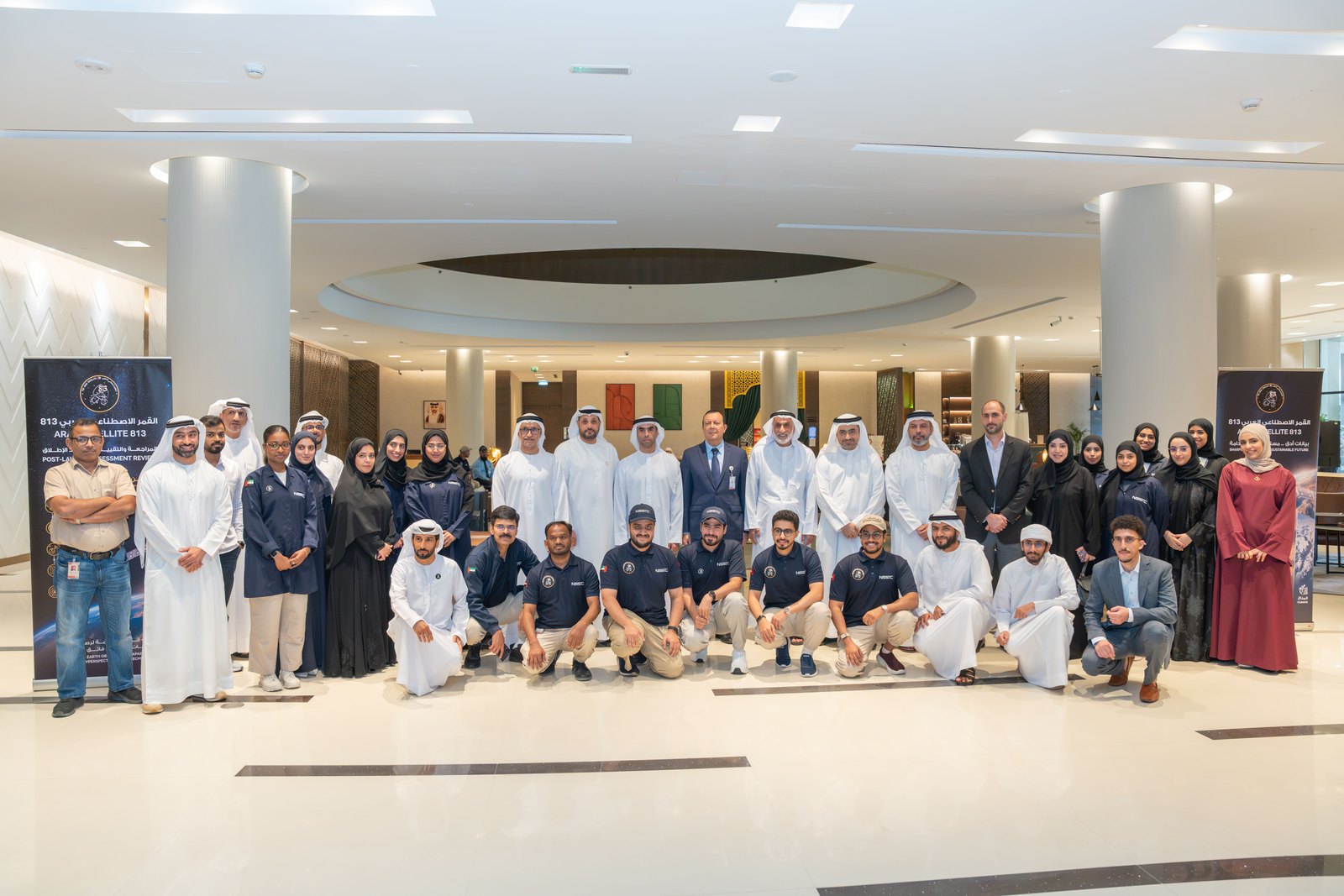
Arab Satellite 813 has passed its Post-Launch Assessment Review, the UAE Space Agency said, a step it described as a significant milestone for the mission.
The satellite is billed as the first joint Arab satellite built for Earth observation and environmental and climate studies. It is funded by the UAE Space Agency and led by the National Space Science and Technology Center (NSSTC) at United Arab Emirates University, with operations based at NSSTC in Al Ain.
The spacecraft went up on 10 December 2025 after finishing its testing campaign at NSSTC. It then went through its Launch and Early Orbit Phase and a commissioning period, during which engineers checked its health, systems and instruments while in orbit. The satellite also took test images to calibrate its imaging equipment, work that fed into the review now completed.
The project draws in expertise from 14 countries through the Arab Space Cooperation Group, with the stated goal of building scientific collaboration and widening access to Earth observation data across the participating nations.
Instruments on board
Three instruments make up the satellite’s payload: a Hyperspectral Imager, a Panchromatic Camera and an Atmospheric Polarimeter.
The Hyperspectral Imager records data across 205 spectral bands for close analysis of the Earth’s surface. The Panchromatic Camera is suited to work needing sharp visual detail, including mapping, and the Atmospheric Polarimeter handles onboard correction for atmospheric effects to sharpen the scientific value of what the satellite records.
The agency said the satellite is intended to serve precision agriculture, water resource management, environmental and climate monitoring, marine and coastal studies, disaster risk management and geological mapping.
Data from the mission will go to member countries of the Arab Space Cooperation Group to support joint research, and the agency said it will help build regional know-how in satellite engineering and Earth observation.
Salem Butti Al Qubaisi, director general of the UAE Space Agency, said the review “marks an important step in our efforts to strengthen Arab cooperation in the space sector and translate our collective capabilities into tangible scientific and economic value.”
He added that the mission will “empower researchers and scientific institutions, and support the development of practical solutions.”
The photo above was issued by UAE Space Agency with the announcement.